
The next evolution of AI is not about replacing Foundation Models. It is about complementing them.
Foundation Models have transformed artificial intelligence, enabling remarkable advances in reasoning, language understanding, planning, coding, knowledge synthesis, and multimodal interaction. They represent one of the most significant technological breakthroughs in the history of AI.
But the next evolution of AI requires more than increasingly capable interactions. It requires systems whose cognition can persist, evolve, and remain governed across interactions.
Artificial Brain Labs is advancing the Persistent Intelligence Project (PIP): A research initiative focused on defining the cognitive capabilities required for intelligent systems to maintain continuity, develop and evolve beliefs, goals, trust, relationships, identity, and learning through experience over time.
As part of this research, ABL is developing Governed Recursive Intelligence (GRI), a reference architecture for implementing Persistent Intelligence. GRI is designed to complement Foundation Models by providing the persistent cognitive layer required to transform powerful interaction intelligence into continuously evolving cognitive systems.
We’re researching the next evolution of intelligence.
GRI: ABL’s Governance-Native Cognitive Kernel
Governed Recursive Intelligence (GRI) is Artificial Brain Labs’ proposed reference architecture for Persistent Intelligence, built around a Governance-Native Cognitive Kernel. GRI is designed to complement Foundation Models by providing the persistent cognitive capabilities required for intelligent systems to maintain continuity, evolve through experience, and remain purpose-driven over time.
Rather than functioning as another Large Language Model, chatbot, or autonomous agent, GRI provides the persistent cognitive layer upon which future intelligent systems can be built. Similar to how an operating system kernel manages fundamental system resources and behavior, GRI governs the cognitive state of an intelligent system—how it learns, evolves, maintains goals, develops beliefs and trust, preserves identity, and makes decisions across interactions.
At the core of GRI is the principle that intelligence is not defined by prediction or interaction alone, but by the governed evolution of a persistent cognitive state. Every meaningful interaction is interpreted as a Cognitive Event, allowing the system to instantiate or update cognitive dimensions such as beliefs, trust, curiosity, goals, preferences, and relationships. Enduring cognitive changes are maintained within the Persistent Cognitive Graph (PCG), enabling cognitive continuity and recursive learning from experience.
GRI also introduces a governance-native approach in which every cognitive state transition is evaluated before becoming part of persistent cognition. This ensures that learning, adaptation, belief formation, trust evolution, and goal changes occur within explicit constitutional constraints rather than emerging as uncontrolled behavior.
Unlike conventional AI architectures that primarily separate training from deployment, GRI is designed to support continuous cognitive development through governed experience. Rather than relying solely on massive offline datasets, an intelligent system can develop and refine its cognitive state incrementally through interactions while preserving identity, purpose, and continuity over time.
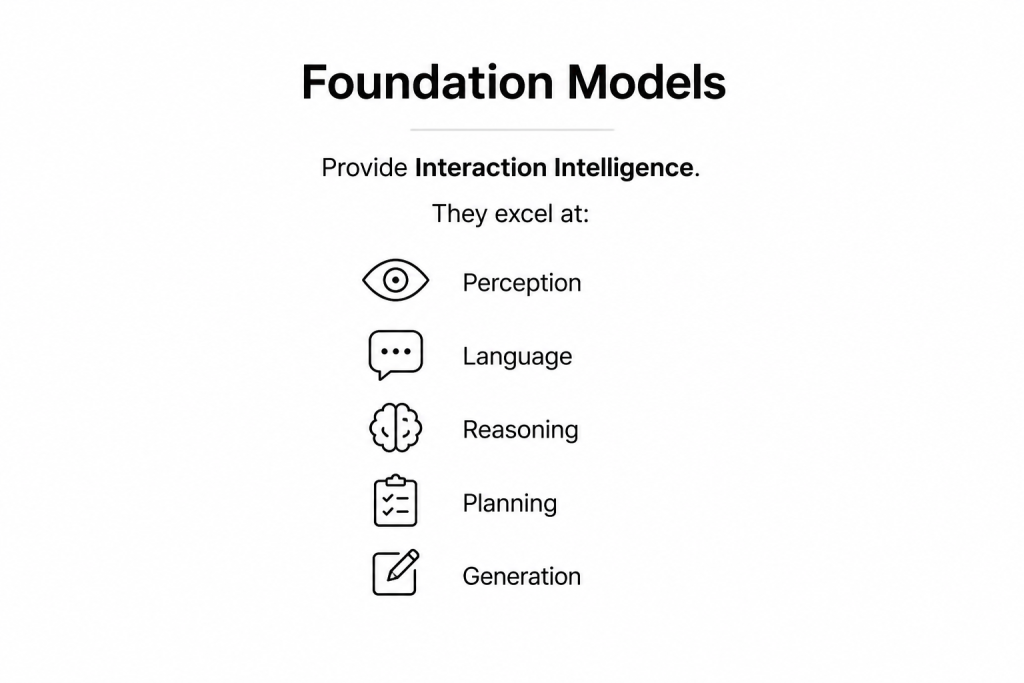
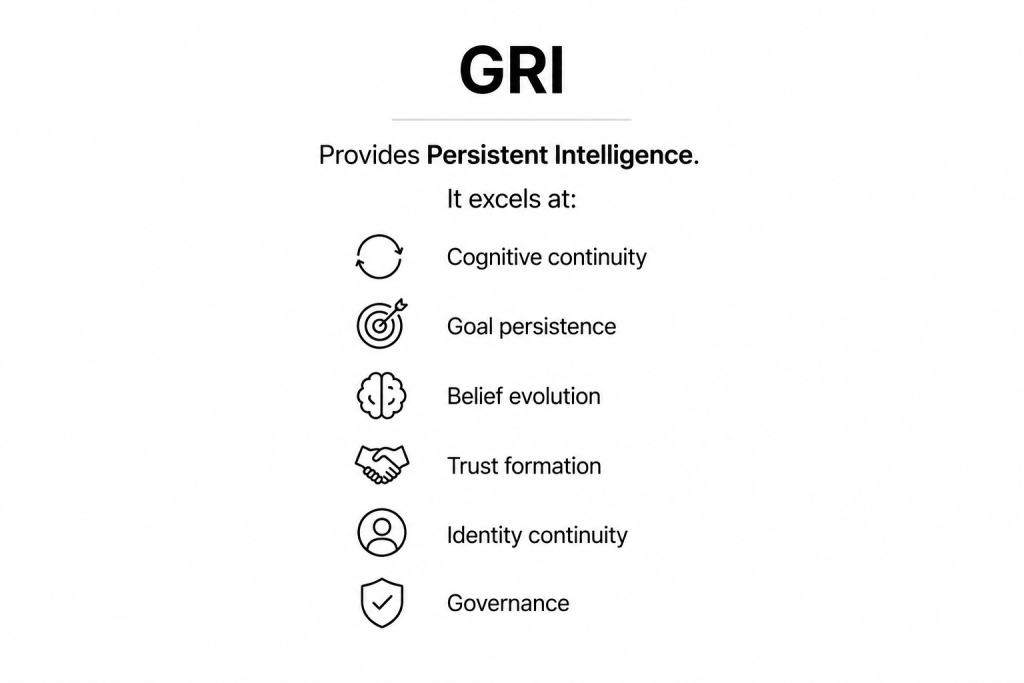
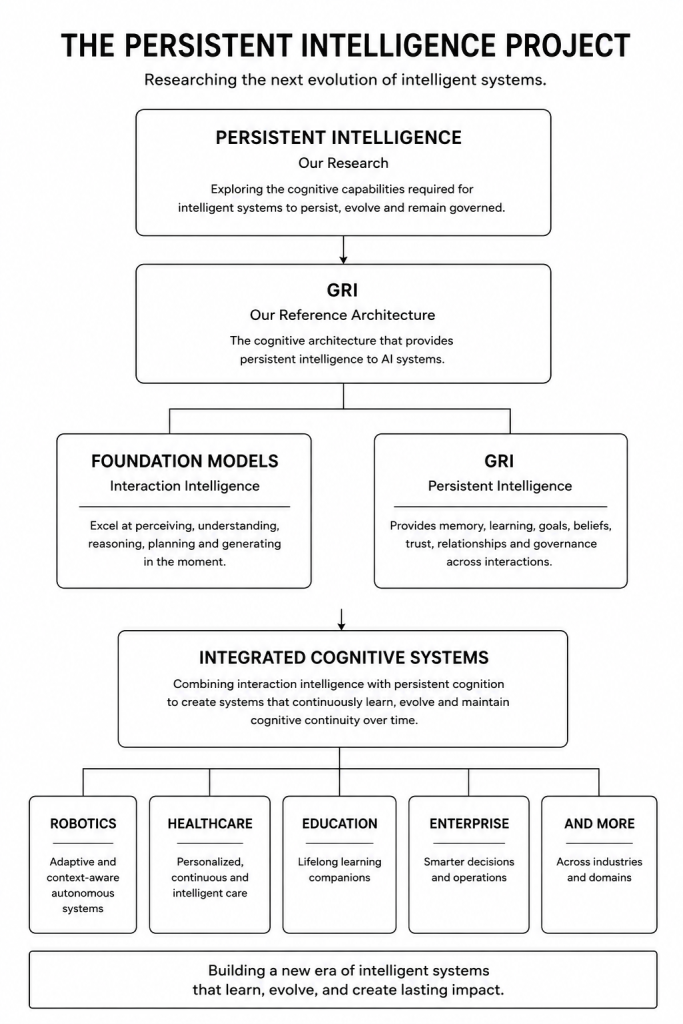
Foundation Models provide Interaction Intelligence. GRI provides Persistent Intelligence. Together they form Integrated Cognitive Systems.
Foundation Models + GRI → Integrated Cognitive Systems
Foundation Models and GRI are designed to perform complementary roles rather than compete with one another.
Foundation Models → Interaction Intelligence
Foundation Models provide the intelligence required for individual interactions, including perception, language understanding, reasoning, planning, knowledge retrieval, and generation. They excel at processing information and producing intelligent responses in the context of the current interaction.
GRI → Persistent Intelligence
GRI provides the persistent cognitive layer that maintains continuity across interactions, enabling evolving goals, beliefs, trust, preferences, relationships, identity, and governed learning over time. It allows the system to retain and evolve its cognitive state rather than treating each interaction as an isolated event.
Integrated Cognitive Systems → The Combined System
When Foundation Models and GRI operate together, they form an Integrated Cognitive System that combines powerful interaction intelligence with persistent cognition. The resulting architecture can reason and act in the present while maintaining, interpreting, and evolving its cognitive state over time.
ABL’s Engineering Objective
Artificial Brain Labs is not focused on building another system that simply answers intelligently – Foundation Models already excel at that. The engineering objective of GRI is fundamentally different: to build a cognitive architecture whose cognition can persist, evolve, and remain governed across interactions. GRI is designed to transform transient experiences into enduring cognitive development, allowing an intelligent system to maintain continuity of goals, beliefs, trust, relationships, identity, and learning over time. This represents the engineering interpretation of Persistent Intelligence. In this architecture, Foundation Models provide Interaction Intelligence, while GRI provides Persistent Intelligence; together, they form Integrated Cognitive Systems capable of combining powerful moment-to-moment intelligence with continuously evolving cognitive state.
The Eight Constitutional Principles of GRI
Persistent Cognition
Intelligence is defined by the continuous evolution of a persistent cognitive state rather than by isolated predictions or responses.
Experience-Driven Learning
GRI learns continuously through governed Cognitive Events and lived experience, rather than relying solely on offline statistical pretraining.
Governance-Native Cognition
Every cognitive state transition shall be evaluated and governed before becoming part of the persistent cognitive state.
Governance is intrinsic to cognition, not an external safety layer.
Unified Cognitive Dimensions
All persistent cognitive properties – including goals, beliefs, trust, curiosity, respect, fear, and future dimensions-share a universal mathematical representation and evolve according to the same governing principles.
Purpose-Driven Intelligence
Every GRI agent possesses a persistent Constitutional Master Goal that provides long-term purpose and guides the generation, prioritization, and evolution of all operational goals.
Cognitive Continuity
Every Cognitive Event contributes to a continuously evolving Persistent Cognitive Graph (PCG), preserving identity, memory, relationships, and lifelong cognitive development.
Separation of Perception and Cognition
Language, vision, speech, sensors, and other modalities belong to the Cognitive Interface Layer.
The Cognitive Kernel processes only standardized Cognitive Events, remaining independent of language, modality, and implementation.
Recursive Cognitive Evolution
Every governed cognitive update influences the interpretation of future Cognitive Events, enabling continuous recursive self-development throughout the lifetime of the intelligent agent.